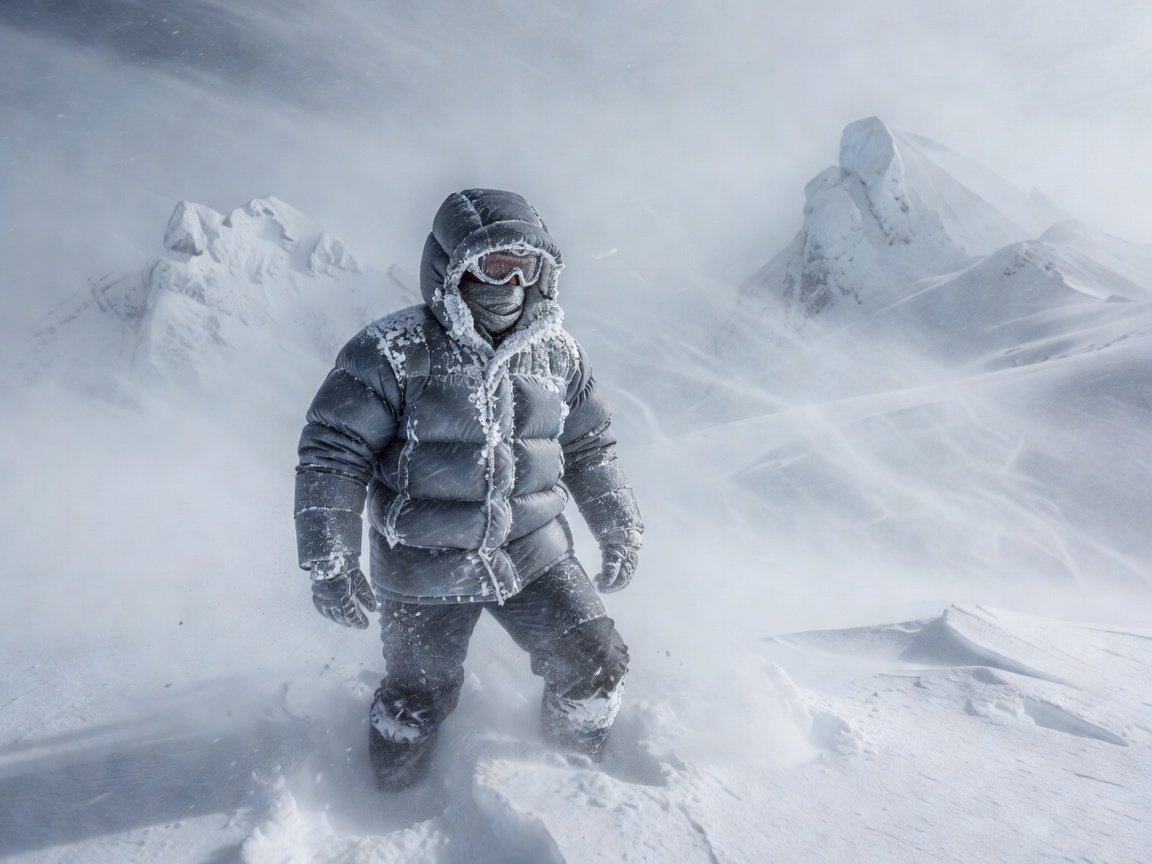
Conquering Austrian Winter Inversions
During deep winter months across Austrian valleys such as the Ennstal and the Inn Valley, temperature inversions trap frigid Arctic air close to the valley floors, causing temperatures to plunge below -20°C. In such conditions, mere hardshell jackets lack the bulk thermal impedance required to prevent core hypothermia.
Insulated mountain coats function as personal microclimate barriers. Their task is to isolate heated air warmed by human metabolic radiation and hold it motionless against exterior thermal gradients.
Down Fill Power Explained (Cuin Standards)
The standard benchmark for natural down insulation is fill power, measured in cubic inches per ounce (cuin):
- 600 to 700 Fill Power: Substantial down clusters suitable for robust everyday alpine town parkas where total garment weight and compressed volume are secondary to durability and lower cost.
- 750 to 850 Fill Power: The premium tier for alpine ski mountaineering and expedition coats. It delivers an outstanding warmth-to-weight ratio, allowing deep cold insulation with minimal pack burden.
- 900+ Fill Power: Ultra-lofted down clusters reserved for extreme high-altitude alpine objectives. While supremely warm per gram, these plumes require delicate ultra-thin shell fabrics that demand careful handling around jagged rock edges.
Baffle Construction: Stitch-Through vs. Box-Wall
How insulation is compartmentalized within a coat is just as consequential as the down fill rating:
In standard stitch-through (sewn-through) jackets, the outer shell fabric is sewn directly to the interior lining fabric. While lightweight and cost-efficient to manufacture, every stitch line creates a zero-insulation "cold bridge" where icy winds can push straight through the seam under breezy conditions.
In contrast, serious alpine parkas utilize box-wall (baffle box) construction. Vertical fabric walls separate the inner and outer shells, creating three-dimensional cubes that allow down plumes to expand fully right up to the partition seams, eliminating cold spots completely.
| Insulation Type | Warmth-to-Weight | Performance in Moisture | Durability / Packability | Ideal Austrian Setting |
|---|---|---|---|---|
| European Goose Down (850+) | Unrivaled High Loft | Poor unless treated with hydrophobic wax | Compresses tightly; lasts 15+ years if kept dry | Glacier summits, evening après in Lech |
| Continuous Filament Synthetic | Moderate to High | Maintains 90% warmth when soaked | Resilient against mechanical dampness | Wet snow at lower valley levels, ski patrol |
| Wool-Insulated Hybrid Batt | Moderate | Exceptional thermoregulation; anti-odor | Moderate weight, completely silent textile | Traditional lodge visits, horse sledges |
Exterior Shell Fabrics: Weatherproof vs. Ultralight
A down coat designed for high-altitude resort strolls through Kitzbühel or Lech requires an outer face treated with a weatherproof polyurethane or PTFE laminate. Untreated ripstop nylon can allow blowing meltwater to reach the down clusters, leading to clumping and total thermal collapse.
Seek out coats with reinforced 70-denier canvas patches across the shoulders and lower arms to withstand the abrasive friction of carrying sharp steel-edged skis and resting on wooden mountain terraces.
Responsible Down Standards (RDS) in the Alpine Region
Within Austria and the European Union, ethical sourcing is rigorously governed. Premium outerwear brands certify their insulation under the Responsible Down Standard (RDS), ensuring down and feathers are obtained exclusively from birds raised without force-feeding or live-plucking practices.